


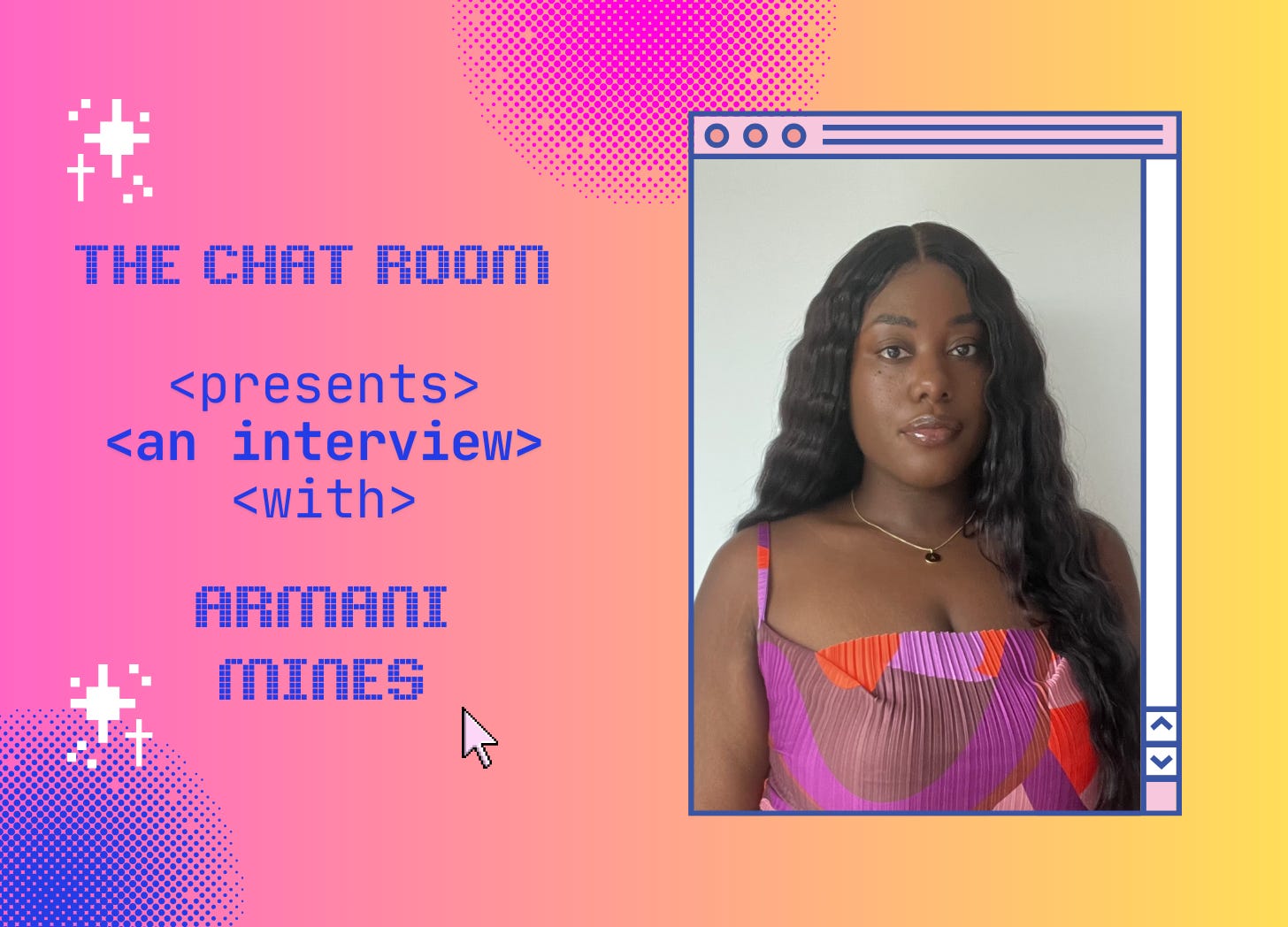
Kristi D. Osorio: Hello, and welcome back to the Chat Room! Thanks for tuning into my first episode, featuring activist, dancer, and organizer Melissa Tanis. I’m back today with the second installment, a conversation with fashion archivist and founder of Black Girls in Archives, Armani Mines.
So, one thing about me is I am completely obsessed with archives and archival studies and archival education. My primary work is in creative nonfiction writing, but I have a secondary interest in archival studies, which intersects in unexpected ways with forms like the memoir and the essay. They are all concerned with the act of remembering, with performing memory work.
The internet has been pretty awful recently, but one of the few bright spots is a page on Instagram called Black Girls in Archives. The tagline defines the space a site for the “GLAM girlies looking to learn, find resources, and community.” For those who don’t know, GLAM refers to cultural heritage sites like galleries, libraries, archives, and museums. Black Girls in Archives provides these resources on Instagram, youTube, SubStack, and even has synchronous virtual programming like their new initiative called Office Hours. Armani and her work with Black Girls in Archives offer an important reminder about why building community matters, and why access to information is a fundamental human right, especially in these times marked by violence, tension, and increasing individualism.
One of the scholars I admire most in archival studies is Dr. Tonia Sutherland, who I’d like to quote as an entry point into my conversation with Armani. In an interview with Sophie Ziegler, Sutherland reflects on the changing archival landscape. She says:
“Archival education comes out of this very traditional French form of education and then from France it gets taken up in England and Australia and Canada and you see the overwhelming whiteness of the profession and we don’t see ideas coming in from the Global South or the African continent or Asia…Every time I feel down or feel like, ‘I don’t know if we’re actually making any progress,’ I see this incremental turn. I hear those voices, I see those faces...I see that indeed, it may be slow and it may be painful, but this ship is turning. It is not sailing in the same direction full speed ahead, as it has been for centuries. I can really see and feel the energy acting against that and it fills me with a tremendous amount of optimism. I believe our future looks bright.”
Black Girls in Archives is yet another reminder of that bright future, even in these dark times. Welcome, Armani Mines, to the Chat Room.
KDO: So instead of starting off with a professional bio, I wonder if you could introduce yourself on your own terms. What’s important for us to know about you? What are your values? What guides you? Who are you?
Armani Mines: Such a loaded question! But I’m Armani Mines. I am a fashion archivist and historian. What I think is important for people to know about me is that I really value amplifying Black voices in archives, and it’s really important to me the preservation of Black history, Black culture within fashion and entertainment. That’s really what my driving source is every single day.
KDO: And I wonder if you could tell us about your journey as an archivist. So, how did you come to this practice? What does it bring to your life?
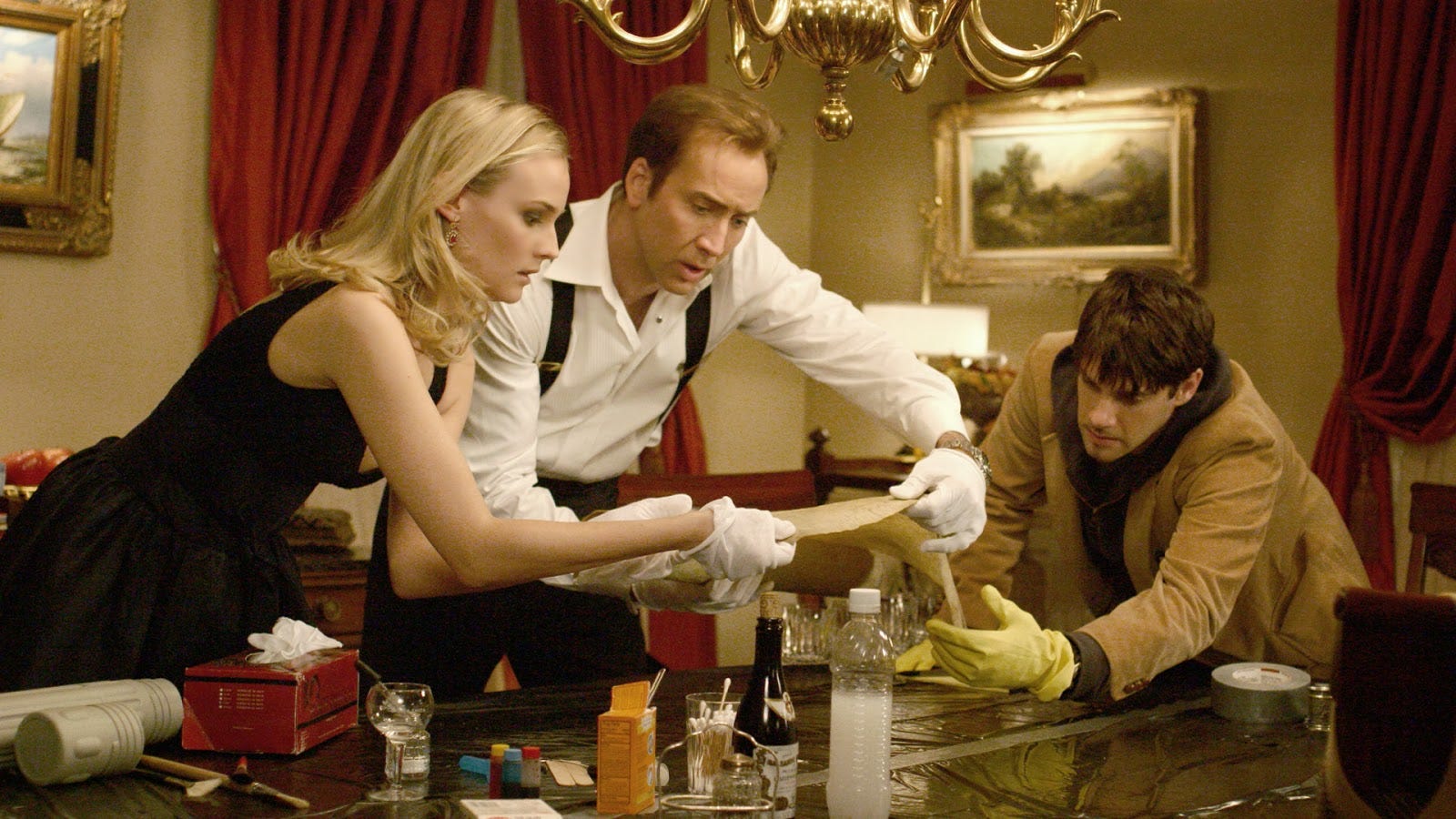
AM: Fashion archiving kind of found me. I was a history major, and that was going okay, and then I took a fashion history class, and I was like, well, I like this. So, I added fashion as a minor and took more fashion classes, but I wanted to figure out how to do more fashion historical work. One day, I was watching one of my favorite movies, National Treasure, and I realized that the lady in the movie was the head of archives at Smithsonian or whatever, but I was like, oh, what’s an archivist? What do they do? So, I looked more into that, and I was like, oh, I wonder if they have something like that for fashion, because as much as I love fashion, I’m not a designer. Historians do a lot of research, but they’re not immersed in the clothes always, and I wanted to find something that would meet me kind of in the middle of research and being immersed in the clothes. I know I wasn’t good at math, so buyer was out, and that’s kind of what I got my major in was fashion merchandising, but I didn’t have a passion for it. So I went home, did a little Google search, and I found a lady who had her own archival company with fashion, and I was like, I want to do that. So, I said, I’m going to do that because she worked for Tom Ford and a few other big brands, and I was like, I have to do that, so it’s been a constant journey of trying to figure out how do I get there. Because on the flip side, fashion archives isn’t a huge well-known thing within the fashion industry, and not every designer has archives, so trying to find my way in this field has been a very hard one, I must say.
When it comes to just trying to get my foot in the fashion door, I just took a fashion internship. I did a fashion internship with Harlem’s Fashion Row, and this particular year, I was tasked to do a research project trying to find Black designers within a certain time frame, and it was so hard. I was finding out about designers that I had no idea about, so that project kind of sparked my interest in solely within Black fashion and entertainment as a whole of like, why are our stories not being amplified as much? This could have been my life’s mission there, but I’ve been back and forth within the archives. I think my first actual fashion archiving internship was with Hood by Air. They’re not a clothing line anymore, I don’t think, but they were really big in like 2016, like they were everywhere. I did an archival internship with them. I worked for the Hip Hop Museum as an archives and collection intern. I worked with Gates Preserve, which is a multimedia archival research, and they do it, they do everything. It’s like a studio, but they’re less. So, I worked with them, but a lot of my finding of my internships came from me just reaching out to people and saying, hey, do you have archives and I can work for you? I also went to NYU for a little bit for costume studies and library information science, and once I got NYU on my resume, more people wanted to talk. So, yeah, that’s kind of how I got here. I’ve done some research for books. I just finished working at Tommy Hilfiger as an archive associate. That was great.
KDO: Wow, that’s awesome. You’ve kind of done it all.
AM: A little bit of everything.
KDO: It’s cool, the idea that it found you and that’s sort of how you got involved in it. So, do you feel that you have managed to become the person from National Treasure, or are you still working toward that?
AM: I think in some aspects, yes, but in my own way.
KDO: Yeah, and I guess I wonder, you know, how did that lead you to starting Black Girls in Archives and how did that come about?
AM: Well, thanks for asking. I actually, when I moved to New York, I was going to school part-time and school was online, but I had to have a job and I just finished a teaching residency program in Washington, D.C., and I moved to New York. So, I started teaching, but teaching, as everyone knows, is a 24/7 job. And since everything’s like shifting back in person, I couldn’t do school and work. And in New York, you kind of have to work. So, I had to pause on school for a while and through teaching, I was like, I really miss archives. And I was trying to figure out how I could get back in that space without actually entering this space again, because I needed my job. But I was on TikTok one day and I ran across the platform, Black Girls in Art Spaces, and I was like, oh, that’s so cool, because they are like a community of Black girls that get together and look at art exhibitions and workshops and things. And I was like, I wonder if there’s anything like that for archives.
I ran across a girl who was documenting her process of transitioning from marketing to archives. And I was like, that’s so cool. I didn’t think anybody would actually be interested in that journey. And her name’s Asha. She’s really big on TikTok. Just seeing her process of going through, changing her whole career and becoming a grad student and doing archives was really interesting to me. So, I was like, I really wish there was a community of people that I could talk to about this. And so, I just created Black Girls in Archives on a random Saturday in my kitchen. And I shared the idea to LinkedIn and it blew up. I put it on Twitter when it was Twitter at the time, and it blew up. And I, every day I’m amazed that I created something, like a platform like this, because I’m very introverted. So, I would have never thought in a million years I would do something like this.
KDO: Wow, that’s awesome. Yeah, it is sad remembering the days before Twitter was a racist cesspool. You were able to sort of tap into that because it was such a great place for actually building genuine community. So, I’m kind of thinking about, you know, your work has a lot of emphasis on preserving Black history and specifically around fashion, and I’m wondering in this time that’s very anti-DEI and there’s a lot of rhetoric around that. And we’ve seen, you know, with the National Archives and things like that over the past couple of years since the latest administration, a lot of whitewashing of our GLAM institutions. I’m sure you heard about, you know, them like, replacing MLK with Elvis and things like that. It’s just kind of a time where preserving the accurate history is so important and that archivists really do have this power to literally rewrite history right in front of us. So, I’m wondering how do you sort of view the role and importance of archiving in these fraught times when we’re seeing history actively being sanitized and whitewashed and ultimately erased from a lot of GLAM institutions?
AM: I think it’s important now more than ever. And I think that’s why I kind of love the field because like everyone who worked in the GLAM sector, no matter like what your respective field is within it, it’s just so important because we are the ones that have the things at our fingertips and we’re able to really give the people the correct information. It’s so easy now with the spread of misinformation, especially on social media. And I see it every day. I work with high schoolers. So, it’s so easy for them to see something on TikTok and then start spreading something. And the historian in me is quickly to say, hey, that’s not correct. So, it’s really important.
But I tell people every day, people archive every single day, whether they know it. Social media is the biggest archive there is right now. Whether you do it on threads or Instagram or Tumblr, whatever your TikTok, whatever your medium is, that is a way of documenting history, whether it’s yours or someone else’s. Even us having this podcast conversation right now is a form of archives. So, I just think everyone can do it in their own way. And it’s just important to continue to push out the true narratives. And my work with Black on the Archives and various other platforms that preserve history in their way are really important for people to follow because it’s really easy. Or I just saw a judge just told Trump he had to put the slaves exhibition back onto the president’s house in Philadelphia. The fact that he was even able to remove that was insane. So, it’s little wins like that. But then it’s just like, why did we have, like, why was that even happening in the first place?
KDO: Yeah, it’s really shocking, actually, to just be like, even to think of that as a little win. It’s like, oh my gosh, like, what kind of dimension are we currently in? So, one thing I really admire about your work is that it kind of goes to show that archiving is accessible. And it’s something that everyone can, and as you said, everyone actually does already engage in doing. And I think it’s really important in this time, especially when these really prestigious institutions are pretty much pandering to this administration. Like, what power do we each have individually and collectively as a community to sort of correct the narrative that’s actively being rewritten in front of us? And so, I think it’s awesome to just kind of remind people that archiving isn’t only housed within these, like, ivory towers, right? It’s also things that we have in our pocket as well. So, that’s something I really admire about your work and about your community.
AM: Thank you. That’s something I really want. And, like, every day I’m like, my goal is to provide resources, create community for people, and make archives accessible. Because even as a person that’s been in the field for a while, it’s still not accessible to me. I walk into places and, like, when I went to NYU, it was like me and maybe one other, two other Black girls in my cohort. In a cohort of, like, 15 to 20 people. And people get in these spaces and they’re like, oh, we can, like, we can be in this space too. And it’s like, yeah, we actually can. But when it looks one way and that’s all you see, you kind of can get, you can get very discouraged. But I don’t care. I like taking up space.
KDO: Yeah, definitely. I think that’s something super interesting at the time where we’re seeing with, like, the library and information science professions—I think people are really realizing how dominated the professions are by white people, and particularly white women, and that it’s kind of a time to open the door. And it’s been time, right? For a long time. And so I think that’s something that’s really heartening about seeing somebody kind of say, I’m taking this into my own hands. And I think that can inspire a lot of people to think in that way and kind of, like, take up their own space, like you said. I think that kind of leads me to a follow up question. So, you know, you said providing resources and stuff like that. I saw you all started doing those Office Hours. And I wonder, how do you see that functioning in this larger mission of Black Girls in Archives? And sort of like, how does the community engage with that?
AM: Office Hours is a new initiative that I thought of people coming in, talking about their respective practice. And that way, it opens up to the community different practices that they didn’t know about or topics that they didn’t know about. Like I said, my goal always for people to learn, it’s actually been a pretty big hit so far. We’ve only had two sessions. We’re about to have our third, I think, this week or next week. But people love them, because they can just come and sit and listen to somebody that’s already a professional. We have people that are, that have been archivists for a long time, or people that are just doing research in the archives, curators, we have all types of people who come and who are on the list to come and listen. But it’s a mix of people that really just want to come and learn about different practices and archives. We had one with Sonja Woods from the Howard Archives, Howard University. We just had Sasha Wells, and she came and she talked about her, her research about Bahamian people, if I’m saying that correctly. People really just come and chat. But I just wanted that hour or so for people to come and learn something new and have a conversation with someone they might not ever have a chance to meet. We do things in person sometimes, but I like that we are in that virtual space, because that opens us up to many more people.
KDO: It’s another way of kind of breaking down the barriers around who has access to archives education, right? And so it goes to show, as much as people love to say that people don’t want to learn and everyone’s lazy, and that’s sort of like such a narrative these days, and I’m in education and I hear that constantly, that goes to show, like, if you just open the door for somebody, they will spend the time and they will come and they will learn. And sometimes it’s the institution of it all that makes it really challenging. Or there’s that question of, am I allowed to be here? Am I allowed to do this? So your work has a big emphasis on fashion, as you said at the beginning. And I wonder if you could talk about how you see fashion intersecting with preservation of Black history and traditions and with memory work as a whole.
AM: Fashion, Black fashion in particular, I feel like is a huge part of fashion, because a lot of the things that we see in current fashion, some way, somehow, it’s probably nine times out of ten influenced by Black culture in some type of way. I think that it’s important to spotlight Black designers, but also spotlight fashion as a whole. Interestingly enough, fashion doesn’t get as much interest on Black Girls in the Workhouse. And I can understand that. There’s so many different respective fields in archives, and fashion archives is still something that is a building, but it’s really important for me to put it out there, because it’s a girl somewhere that was like me, who wanted to know more about fashion history. And I think fashion as a whole is, little by little, starting to be more inclusive endeavors, but not a lot, especially when it comes to designers. Because I was just listening to Sergio Hudson. He just had his big New York Fashion Week first 10 year anniversary, and he was just like, I can’t wait until people just look at me as a designer, not a Black designer. And I think we’re still dealing with that token of, why can’t I just be seen as a designer like anyone else, or a historian as anyone else? It’s like, you have to put the race thing in there, but I’m just as talented, I work just as hard as these other designers.
But I think Black fashion, and fashion as a whole, just plays a huge part in archives. Just because when I was younger, I used to go to exhibitions a lot, to museums and stuff, and I remember going to see the First Lady gowns at the Smithsonian. I love stuff like that. Even going to be able to see movies. And I went to, I think it was a Hollywood costume exhibition a few years ago, maybe in high school, and I thought that was really cool because I get to see some of my favorite movies. But if you do the research in it, one of my favorite movies is Gone with the Wind. And very controversial, honestly. But the one of the milliners who created the hats was a Black woman [Mildred Blount]. But a lot of people don’t know that because they don’t go so far. They’re like, oh, I really like this hat. But they’re just like, oh, it’s a hat from Gone with the Wind. But if you really go deep into it, you’ll see a Black woman created the hats. And it’s probably a bunch of more instances of that. Even the Playboy bunny costume, a Black woman [Zelda Wynn Valdes] created that. A lot of people don’t know. So yeah, we’re in there.
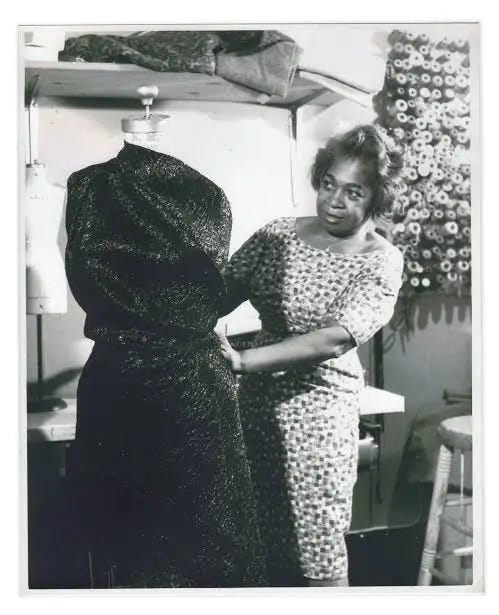
KDO: Yeah, that’s so interesting. I didn’t know either of those two things, and those are just like, iconic fashion moments. So that’s really interesting to hear about. And I think also in the context of like, thinking about Playboy, I feel like that’s a, I don’t know this for a fact, but is giving a pretty racist vibe around bodies and types of women that are considered desirable. That adds a really interesting layer onto the history of that organization. So I’m definitely going to look that up after this. Thank you. Yeah, and so I guess, so we’re in this uncertain time with everything we’ve been seeing going on, just this year in 2026 alone, I feel like there hasn’t been a moment of peace. So in these times of tension, violence, grief, and even as we mentioned earlier, erasure, I wonder what’s a pressing issue you’re concerned with right now, and what others might be able to do to help or get involved?
AM: I think for me, the biggest thing is kind of something we’ve already talked about, and it’s just the erasure of Black history.vI just saw, maybe a few weeks ago, where Trump was like, civil rights was bad for white people too, and I’m like, what? So it’s just like, where are you getting this? Who told, like, it’s very, it’s very scary with everything that’s going on in the world. And not just for African Americans, but for Hispanics as well. And I feel like every day I’m looking at something. Like…ICE. I just heard ICE is coming to New York, and I’m like, my goodness, why? Like, what is the point of any of this? So I think what’s important is us to continue to do what our, the people before us did, and that was to do whatever we could to resist, and continue to create things, and focus on our joy in these dark moments. Even though things look bleak, they do get better. Hopefully, within the next, how many more years we got? Three years, people, as they are slowly starting to do, wake up and choose, and choose better, and educate themselves in this time, as much as they can, and do the research themselves. Don’t just take things for face value, what you see on the It’s really hard to decipher between what’s AI and what’s real information. It’s honestly the same thing I tell my kids. Nothing’s gonna, nothing’s gonna beat you knowing how to find out information on your own, and not just taking things for face value.
KDO: Yeah, that’s a great point, and it’s something that we all can do, right? And so it actually is a tangible action that everybody can just spend a little bit more time when we are scrolling on the internet, or when we’re hearing somebody talk about something, just to take that extra time, and maybe do a little critical thinking, a little information literacy moment. So yeah, I’m with you on that. Is there anything else you may want to talk about that we haven’t touched upon that you might want to put out there?
AM: I guess I would just continue to urge people to get invested in your local archives. You can start an archive and go to your library. They do scanning. Most of them do scanning for free, so you can get into that. Document your family history, because who knows who’s going to become a big star one, and they might be like related to you or something, and then they might try to like tell a whole different story. But yeah, Obstetrics and Resistance looks a lot different than what it used to. You don’t always have to get out in the streets and make these picket signs and walk, because that’s that was 2020. Now we’re in 2026, and I’m not saying that anybody who does that is wrong, because they’re not. I’m saying find your way that you feel like is your protesting, whether that is you just getting on Instagram or TikTok and saying whatever you got to say, or fighting systems that do not fit for everyone. When I truly think about it, Black Girls in Archives is the way of me protesting the whitewashed system that we have, and having us create the space for Black women to get into the field, but also for them to learn. I know one thing that I really wish I had getting into the field of archiving was more resources and more people to talk to, and that’s some things I’m really trying to combat with Black Girls in Archives. I think that the more we document history right now in the ways that we can, years later, even once this is over, it’s going to help.
KDO: Yeah, that’s awesome. Well, thank you so much, Armani, for your time. I’m just really grateful and excited to tell more people about your page. I think it’s just so important.
AM: Thank you so much for even being interested in talking to me, and being interested in Black Girls in Archives. I truly, truly appreciate it.
Follow Black Girls in Archives: Instagram, TikTok, YouTube, SubStack
Armani Mines is a Fashion Historian and Archivist from Richmond, Virginia. She holds a B.A. in History and a B.S. in Fashion Merchandising from Old Dominion University and pursued dual master’s degrees in Costume Studies and Library & Information Science at New York University, where she refined her focus on fashion archives, material culture, and preservation. Her professional experience spans brand and archival work. She interned with Harlem’s Fashion Row and contributed to the Fashion in Color coffee table book. She has supported major projects and campaigns in collaboration with global brands and media platforms, including Nike x LeBron James, TRESemmé, OWN, and Essence.
Mines has held archival roles with Hood By Air, The Hip-Hop Museum, and The Gates Preserve, and previously served as an Archive Associate at Tommy Hilfiger, where she contributed to preserving and interpreting fashion heritage through research, documentation, and storytelling within Digital Archives. In 2024, she founded Black Girls in Archives, an initiative committed to uplifting Black women in the archival field and preserving Black stories in history across fashion, music, and entertainment and more. At its core, BGIA is dedicated to safeguarding cultural memory while creating opportunities for the next generation of Black women archivists.


